Showing posts with label Af-Pak. Show all posts

Sunday, February 1, 2015

Ashraf Ghani and the Pashtun Dilemma

Ashraf Ghani and the Pashtun Dilemma
Ashraf Ghani and the Pashtun Dilemma, If he is to succeed, Afghanistan’s president will need to come to grips with the country’s ethnic tensions. 
By Ali Reza Sarwar


With his impressive background, which includes a stint as a senior official at the World Bank and a ministerial post, Afghan President Ashraf Ghani would not appear to be short of qualifications for leadership. Yet, the president appears on course to be just another Afghan leader who is unable to rule the troubled country. When Ghani delivered his lofty inaugural speech on September 29, 2014, following a disputed election and power-sharing deal, expectations were high. The president made a strong argument in support of what he called the “triangle of stability” – economy, security and human resources – promising to restore Afghanistan’s valuable ancient geopolitical and economic position as the “crossroads of Asia.”

More than 100 days after taking the office, however, and Ghani is bogged down in a serious political crisis, one that draws a gloomy picture of the fragile unity government. He has only in the last few days been able to form a cabinet, leaving Afghanistan’s major public institutions, including ministries, independent departments, and commissions without leaders for months. A recent survey conducted by Afghanistan’s popular private TOLO TV and an independent civil society, shows that Ghani’s popularity has fallen dramatically, with only 27.5 percent of respondents satisfied with his leadership. With insecurity and political uncertainty looming, a number of parliamentarians have asked for Ghani’s impeachment for “treason,” blaming him for Afghanistan’s current state of disarray.

What has gone wrong? Why is this impressively credentialed leader unable to fix Afghanistan? Traditionally, Afghanistan’s woes have been blamed on crippling corruption, weak governance, dismal economic conditions, and worsening security coupled with foreign intervention. While these are certainly painful realities, the root cause of political crisis lies in ethnic politics and the breakdown of consensus among diverse ethnicities in regard to the persistent Pashtun dilemma.

The Pashtun Dilemma

Constituting around 40 percent of the population, Pashtuns are the largest ethnic group in Afghanistan and are on the front lines of the war on terrorism, both as perpetrators and victims. The Taliban that is behind the bulk of the brutal militancy both in Afghanistan and Pakistan are mainly Pashtuns and derive their support from strongholds in tribal areas across Afghanistan and Pakistan’s borders. The mainstream Pashtun intelligentsia in both countries have been mostly uncertain over whether to sympathize with the Taliban as a nationalist movement seeking to restore traditional Pashtun dominance in Afghan politics and to some extent in Pakistan, or to condemn them as an extremist and externally infiltrated militancy that have dragged Pashtuns into an asymmetric confrontations with the U.S.-led coalition at a massive cost in human life.

Despite the Taliban’s indiscriminate attacks on Pashtun areas, including the last year’s suicide bombing in a market in Paktika province that killed 89 people, some leading Pashtun thinkers support the Taliban as a nationalist movement that could restore Pashtun dominance in Afghanistan, which they believe declined following the fall of the Afghan monarchy in 1973 and the following decades of the Soviet invasion and civil wars. For instance, in his article, the decline of Pashtuns in Afghanistan, Anwar Ul-Haq Ahady, a former finance and commerce minister under Karzai and an influential Pashtun thinker, believes that the decline of Pashtuns in Afghanistan after the fall of Najibullah in 1992, was “more significant than the fall of communism. The rise of the Taliban generated optimism among the Pashtuns about the reversal of their decline.”

The view that the Taliban could serve as a powerful Pashtun nationalist movement with the ability to reverse the post-Taliban inter-ethnic relations and political landscape of Afghanistan remained largely visible in during the administration of President Hamid Karzai. Karzai was frequently criticized by the opposition for his lenience towards the Taliban, yet he continued to compromise and push for negotiation. For its part, the Taliban categorically rejected talks, humiliating Karzai as a “puppet and unauthorized” to negotiate. At the grassroots level, particularly in non-Pashtun circles, there has been a difficult debate over whether Karzai would have been as willing to compromise if the Taliban had been a non-Pashtun movement.

Ghani’s Test of Leadership 

Ghani, a Pashtun himself, already seems incapacitated by the Pashtun factor. If he is to get to grips with the problem, he will need to address several important issues.

First, it should be realized that the war on terror is being fought mainly in Pashtun areas of Afghanistan and Pakistan, and this reality constrains the political status of Pashtun in both countries. To overcome this, Pashtun leaders and intelligentsia, including Ghani himself, need to draw a stark line between the Taliban as a radical movement linked to global terrorist networks, and the legitimate cause of Pashtuns for justice. Fail to do that and Pashtuns will only be more isolated in both Afghanistan and Pakistan, and forever in conflict with non-Pashtun groups and the international community. Breaking with the Taliban should also not be limited to the official level; the debate should move to the heart of Pashtun tribes and traditions that continue to provide the Taliban with sanctuaries and new recruits.

Second, the dynamics of ethnic relations and politics have fundamentally changed in Afghanistan and Pashtuns must face the reality that the time for a despotic monarchy or factional regime like that of the Taliban has passed. In the worst possible scenario, the collapse of Afghanistan’s fledgling democracy and unity government could lead to chaotic civil war, but it will not permit the emergence of a Pashtun-dominated government, just as it will not allow a government that excludes Pashtuns. Pashtuns will need to renegotiate their relationship with other ethnic groups in Afghanistan and this will inevitably mean giving up some of the privileges they enjoyed in earlier times.

Ghani could play a pivotal role in pushing this message among Pashtuns, but he seems to be replicating the failings of his predecessor. Like Karzai, Ghani is uncertain whether to consider the Taliban enemies or political dissidents. For the moment, he believes they are political opponents, a designation that would baffle many Pashtuns and all non-Pashtuns who have suffered under the Taliban’s violence. Ghani has been clear on his desire to reach a diplomatic settlement with Pakistan, and has also increased his contacts with nationalist Pashtun leaders in Pakistan. In fact, he recently hosted them in Kabul, a risky move that will have infuriated Pakistan’s government and intelligence agency given Pakistan’s long obsession with Pashtun nationalism.

Clearly, there will be no peace in Afghanistan, Pakistan, or the region without the genuine participation of Pashtuns. Yet Pashtuns’ failure to engage constructively with non-Pashtuns in a democratic process that rejects the Taliban will only lead to their isolation. Ghani is the one man who could achieve this engagement, and he will need to do so if he desires to escape the fate of other Afghan rulers.

Ali Reza Sarwar is a Fulbright Graduate Fellow at Texas A&M University, Bush School of Government and Public Service where he is completing a master’s degree in Intelligence and National Security. Reza graduated from the American University of Afghanistan (AUAF) where he was also in charge of the university’s enrollment management plan.

source: http://thediplomat.com/2015/01/ashraf-ghani-and-the-pashtun-dilemma/


Wednesday, September 24, 2014

THE FATHER OF TALIBAN –USA Funded Jihadist Textbooks Created in University of Nebraska

1984-1994: CIA Funds Militant Jihadi Textbooks for Afghanistan and Pakistan : 
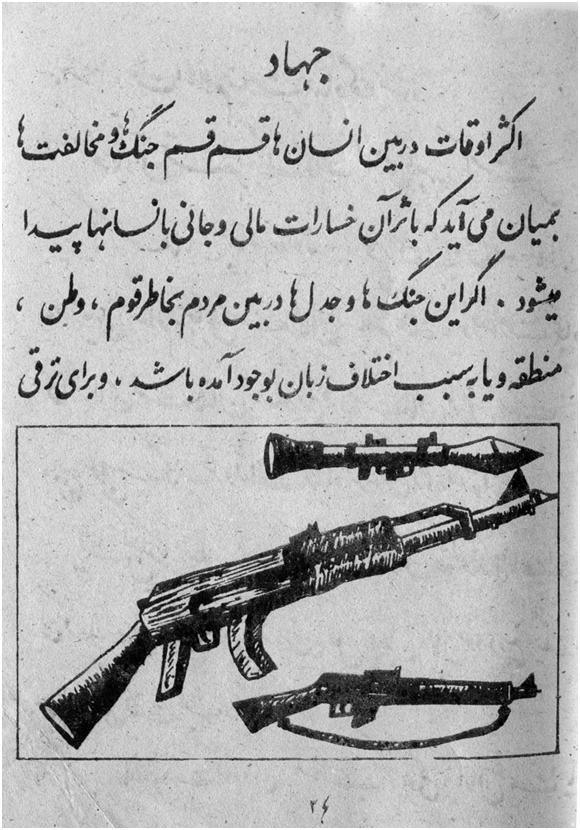
The US, and CIA through USAID and the University of Nebraska, and through Thomas Gouttierre,( Father of Taliban and thier Jihadi literature ),  spends millions of dollars developing and printing textbooks for Afghan schoolchildren. The textbooks are “filled with violent images and militant Islamic teachings, part of covert attempts to spur resistance to the Soviet occupation.” For instance, children are “taught to count with illustrations showing tanks, missiles, and land mines.” Lacking any alternative, millions of these textbooks are used long after 1994; the Taliban will still be using them in 2001.
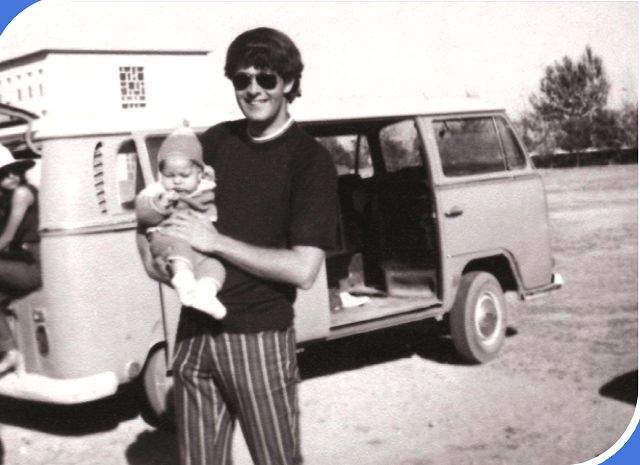
Dr Thomas Gouttierre with His Wife and Son in Afghanistan while in Peace Corps 1964-74.
Dr Thomas Gouttierre with His Wife and Son in Afghanistan while Peace Corps 1964-74.
Thomas Gouttierre went to Afghanistan in 1964 as a Peace Corps volunteer. He returned to the United States in 1967 and earned a master’s degree in Islamic Studies at Indiana University. In 1969 he went back to Afghanistan as a Fulbright Scholar. He stayed on to work for the Fulbright Foundation’s Afghan-American Education Commission after the conclusion of his two-year fellowship. In 1974 Gouttierre became director of the Center of Afghanistan Studies at the University of Nebraska at Omaha
Dr Thomas Gouttierre Served in Afghanistan in 1964-69 in Peace Corps and Had Links with Taliban since then .
In 2002, the US will start producing less violent versions of the same books, which President Bush says will have “respect for human dignity, instead of indoctrinating students with fanaticism and bigotry.” (He will fail to mention who created those earlier books.) (Stephens and Ottaway 3/23/2002; Off 5/6/2002) A University of Nebraska academic named Thomas Gouttierre leads the textbook program. Journalist Robert Dreyfuss will later reveal that although funding for Gouttierre’s work went through USAID, it was actually paid for by the CIA.
Af-Pak Jihadi Text Book Printed in  Pakistan ISI  via Afghan Lyceum and Supplied to Afghan refugees to Develop Jihad for Great Game
Af-Pak Jihadi Text Books About 13 Million in last 30 Years Printed in Pakistan via ISI and Afghan Lyceum and Supplied to Afghan refugees to Develop Jihad for Great Game
These Book were distributed in Afghan refugees camps in peshawar and FATA and Pakhtunkhwa area from a office in Peshawar run by Mujahideen and Al-qaeda Memeber under ISI and CIA , Project known as Afghan Lyceum and it was still running now in Islamabad even today .
Enron Gives Taliban Millions in Bribes in Effort to Get Afghan Pipeline Built .
Unocal will pay Gouttierre to work with the Taliban (see December 1997) and he will host visits of Taliban leaders to the US, including trips in 1997 and 1999 (see December 4, 1997 and July-August 1999). (Dreyfuss 2005, pp. 328) 1996-September 11, 2001:
The Associated Press will later report that the Enron corporation bribes Taliban officials as part of a “no-holds-barred bid to strike a deal for an energy pipeline in Afghanistan.” Atul Davda, a senior director for Enron’s International Division, will later claim, “Enron had intimate contact with Taliban officials.
” Presumably this effort began around 1996, when a power plant Enron was building in India ran into trouble and Enron began an attempt to supply it with natural gas via a planned pipeline through Afghanistan (see 1995-November 2001 and June 24, 1996). In 1997, Enron executives privately meet with Taliban officials in Texas (see December 4, 1997). They are “given the red-carpet treatment and promised a fortune if the deal [goes] through.” It is alleged Enron secretly employs CIA agents to carry out its dealings overseas.
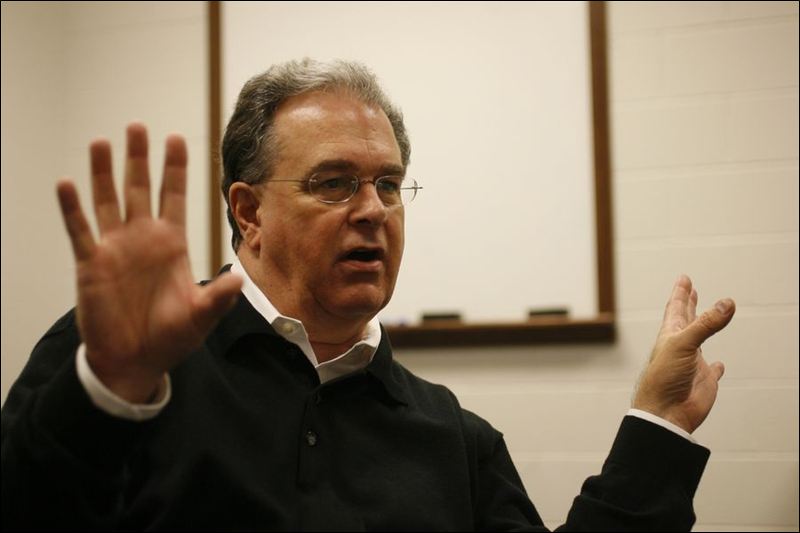
Dr Thomas Gouttierre of University of Nebraska USA .
According to a CIA source, “Enron proposed to pay the Taliban large sums of money in a ‘tax’ on every cubic foot of gas and oil shipped through a pipeline they planned to build.” This source claims Enron paid more than $400 million for a feasibility study on the pipeline and “a large portion of that cost was pay-offs to the Taliban.” Enron continues to encourage the Taliban about the pipeline even after Unocal officially gives up on the pipeline in the wake of the African embassy bombings (see December 5, 1998).
An investigation after Enron’s collapse in 2001 (see December 2, 2001) will determine that some of this pay-off money ended up funding al-Qaeda. (Barrett 3/7/2002)
June 24, 1996: Uzbekistan Cuts a Deal with Enron :
Uzbekistan signs a deal with Enron “that could lead to joint development of the Central Asian nation’s potentially rich natural gas fields.” [Houston Chronicle, 6/25/1996] The $1.3 billion venture teams Enron with the state companies of Russia and Uzbekistan. [Houston Chronicle, 6/30/1996] On July 8, 1996, the US government agrees to give $400 million to help Enron and an Uzbek state company develop these natural gas fields. [Oil & Gas Journal, 7/8/1996]
Unocal Establishes Pipeline Training Facility Near Bin Laden’s Compound: 
Thomas Gouttierre. [Source: University of Nebraska] Unocal pays University of Nebraska $900,000 to set up a training facility near Osama bin Laden’s Kandahar compound, to train 400 Afghan teachers, electricians, carpenters and pipe fitters in anticipation of using them for their pipeline in Afghanistan.
Dr Thomas Gouttierre of University of Nebraka Omaha who Wrote these Jihadi Books for Mujhaideen and Taliban
One hundred and fifty students are already attending classes in southern Afghanistan. Unocal is playing University of Nebraska professor Thomas Gouttierre to develop the training program. Gouttierre travels to Afghanistan and meets with Taliban leaders, and also arranges for some Taliban leaders to visit the US around this time (see December 4, 1997). (Lees 12/14/1997; Coll 2004, pp. 364)
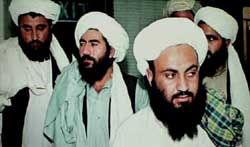
December 4, 1997: Taliban Representatives Visit Unocal in Texas Taliban representatives in Texas, 1997: 
It will later be revealed that the CIA paid Gouttierre to head a program at the University of Nebraska that created textbooks for Afghanistan promoting violence and jihad (see 1984-1994).Gouttierre will continue to work with the Taliban after Unocal officially cuts off ties with them. For instance, he will host some Taliban leaders visiting the US in 1999 (see July-August 1999).
[Source: Lions Gate Films] Representatives of the Taliban are invited guests to the Texas headquarters of Unocal to negotiate their support for the pipeline. Future President George W. Bush is Governor of Texas at the time. The Taliban appear to agree to a $2 billion pipeline deal, but will do the deal only if the US officially recognizes the Taliban regime.
The Taliban meet with US officials. According to the Daily Telegraph, “the US government, which in the past has branded the Taliban’s policies against women and children ‘despicable,’ appears anxious to please the fundamentalists to clinch the lucrative pipeline contract.” A BBC regional correspondent says that “the proposal to build a pipeline across Afghanistan is part of an international scramble to profit from developing the rich energy resources of the Caspian Sea.” (BBC 12/4/1997; Lees 12/14/1997)
It has been claimed that the Taliban meet with Enron officials while in Texas (see 1996-September 11, 2001). Enron, headquartered in Texas, has an large financial interest in the pipeline at the time (see June 24, 1996).
The Taliban also visited  Thomas Gouttierre,( Father of Taliban and thier Jihadi literature )  an academic at the University of Nebraska, who is a consultant for Unocal and also has been paid by the CIA for his work in Afghanistan (see 1984-1994 and December 1997). Gouttierre takes them on a visit to Mt. Rushmore. (Dreyfuss 2005, pp. 328-329) July-August 1999: Taliban Leaders Visit US About a dozen Afghan leaders visit the US. They are militia commanders, mostly Taliban, and some with ties to al-Qaeda. A few are opponents of the Taliban. Their exact names and titles remain classified. For five weeks, they visit numerous locales in the US, including Mt. Rushmore.
All their expenses are paid by the US government and the University of Nebraska. Thomas Gouttierre, an academic heading an Afghanistan program at the University of Nebraska, hosts their visit.
Gouttierre is working as a consultant to Unocal at the time, and some Taliban visits to the US are paid for by Unocal, such as a visit two years earlier (see December 4, 1997). However, it is unknown if Unocal plays a role in this particular trip. Gouttierre had previously been paid by the CIA to create Afghan textbooks promoting violence and jihad (see 1984-1994).  (Berens 10/21/2001)
July-August 1999: Taliban Leaders Visit US
About a dozen Afghan Taliban Leaders visit the US. They are militia commanders, mostly Taliban, and some with ties to al-Qaeda.
A few are opponents of the Taliban. Their exact names and titles remain classified. For five weeks, they visit numerous locales in the US, including Mt. Rushmore. All their expenses are paid by the US government and the University of Nebraska.Thomas Gouttierre, an academic heading an Afghanistan program at the University of Nebraska, hosts their visit.
Taliban in Texas as Guest of George Bush Governor Texas and Unicol
Gouttierre is working as a consultant to Unocal at the time, and some Taliban visits to the US are paid for by Unocal, such as a visit two years earlier (see December 4, 1997).
However, it is unknown if Unocal plays a role in this particular trip. Gouttierre had previously been paid by the CIA to create Afghan textbooks promoting violence and jihad (see 1984-1994). It is unknown if any of these visitors meet with US officials during their trip. [Chicago Tribune, 10/21/2001]
source:  http://www.historycommons.org/context.jsp?item=a84textbooks&printerfriendly=true